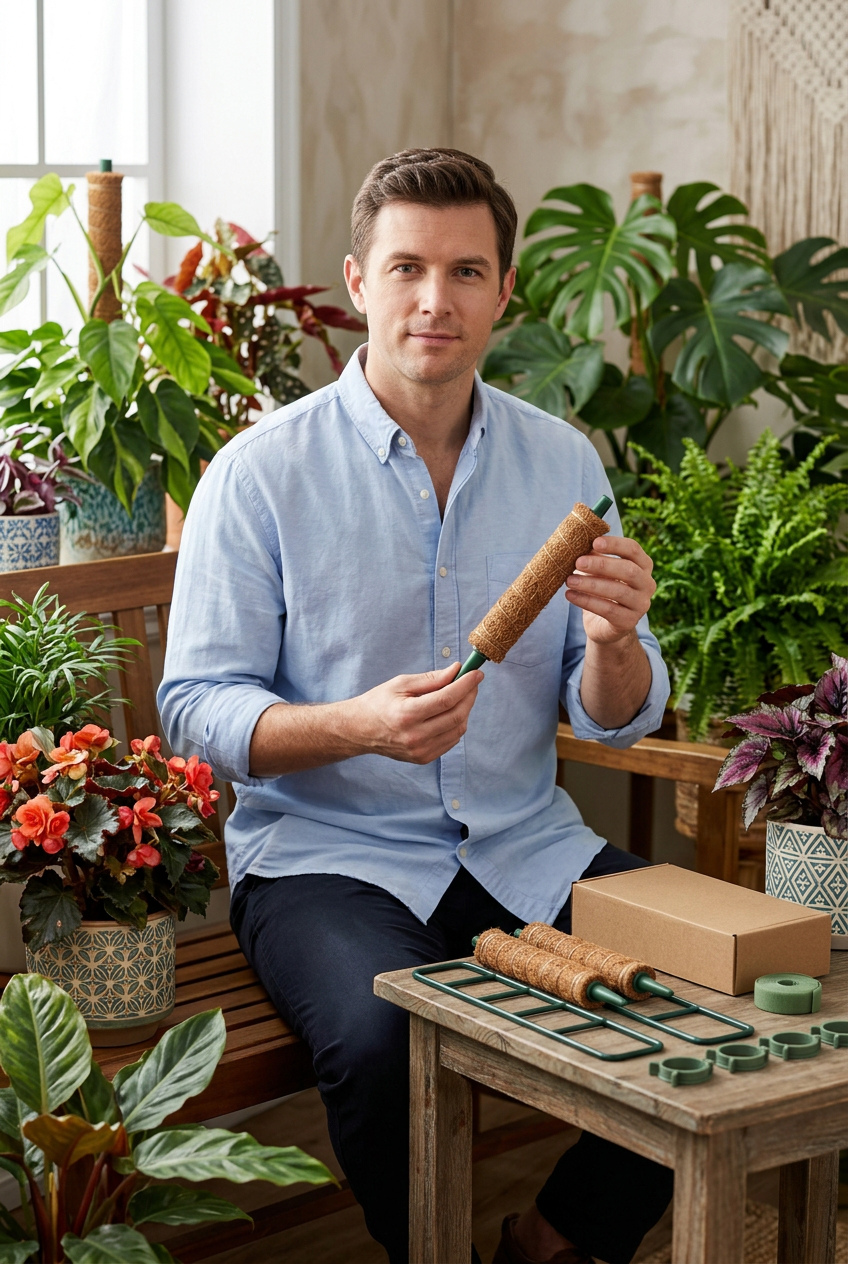
Climbing Houseplant Support Kit with Four Fiber-Wrapped Pole Sections, Two Ladder Trellises, Ten Plant Clips & Green Tie Roll for Gentle Vine Training
Climbing Houseplant Support Kit with Four Fiber-Wrapped Pole Sections, Two Ladder Trellises, Ten Plant Clips & Green Tie Roll for Gentle Vine Training
Couldn't load pickup availability

🪜 Let the Plant Set the Pace. Give It a Direction to Explore.
A vine has reached the edge of the shelf. A new stem is leaning away from its pot. The plant you brought home as a small cutting is beginning to occupy a little more space than you expected.
That is a good moment to pause and consider its next arrangement, not to pull every stem into a perfect line.
This Climbing Houseplant Support Kit brings together two different support shapes and coordinating fastening accessories. Four brown fiber-wrapped pole sections, two deep green ladder trellises, ten sage-colored clips and a green tie roll give you options for planning gentle support around suitable small houseplants.
The aim is a considered display that remains accessible for care. Your plant still decides how it grows, and its needs should guide every adjustment.
First Decision: A Pole or a Ladder?
Choose a narrow upright form
The wrapped pole sections offer a cylindrical surface beside a suitable upright or climbing stem. Their brown fibrous exterior adds an earthy texture that sits naturally among foliage, while the green ends coordinate with the rest of the collection.
Place a section where it can be installed securely without forcing its insertion point through established roots. Check the plant, pot depth and available space before deciding whether this form is appropriate.
The sections have connector-style ends. Join components only as directed by the supplied assembly instructions, and stay within the confirmed configuration limits. Four sections in a box do not mean that every possible stacked arrangement is stable or suitable.
Choose a small framework
The two ladder-style trellises each have a rounded rectangular top, three horizontal rungs and two insertion legs. Their open shape provides a framework around which suitable flexible growth can be arranged.
Use a trellis when the plant and container suit that shape. Keep foliage from being compressed against a rung, and leave access to the potting surface for watering and inspection.
Neither support is a remedy for every leaning plant. Poor light, root problems or another care issue may need attention before training makes sense.
Second Decision: Where Should the Support Sit?
Begin with the pot on a level surface. Look at where the main stems emerge, where new growth is forming and where you can place the support without crowding the crown.
Installing during an appropriate repotting session may give you a clearer view of the root ball. For an established planting, do not push blindly through resistance. Stop and reassess rather than forcing a pointed end deeper.
The container needs to remain stable with the chosen support and plant in place. A tall arrangement in a small or lightweight pot can become unbalanced. Do not rely on tight ties to compensate for an unstable base.
Check the final product dimensions and the supplied installation guidance before use. This set is intended for suitable small container plants, not heavy branches, fruit-laden crops or structural loads.
🔗 Third Decision: A Clip or a Tie?
Use a clip only when the fit is right
The ten sage-colored hinged ring clips provide individual fastening points for compatible arrangements. Open and close a clip gently, making sure it is not pinching a leaf, trapping soft new growth or pressing against a node.
A fixed-size clip is not suitable for every stem. If it leaves an indentation, squeezes the plant or does not close comfortably around the intended arrangement, do not force it into use.
Avoid fastening leaf stalks merely because they are easy to reach. Follow plant-specific training guidance to identify an appropriate stem or attachment position.
Use the tie roll to choose your placement
The green tie roll lets you prepare individual lengths for suitable attachment points. Leave room for movement and thickening rather than fastening the plant tightly against the support.
Keep any cut end away from tender growth. If cutting is needed, use an appropriate cutting tool safely; scissors are not included in this kit.
A tie should guide position without becoming a constricting band. Check it again as the plant changes, even when it looked comfortably loose at the start.
A Gentle Training Session, from Start to Finish
- Observe the natural direction. Identify flexible growth and check the plant’s training requirements. Do not assume an old, rigid stem can be bent into a new shape.
- Choose the support. Compare the pole and trellis forms with the plant’s size, container and available space.
- Secure the base appropriately. Follow the product instructions, avoid root damage and confirm the pot remains balanced.
- Guide a little at a time. Move growth gently toward the support. Stop if you feel resistance or see tissue bending sharply.
- Fasten without pressure. Choose suitable clips or ties, keeping leaves and delicate growth clear.
- Step back and inspect. Check from several angles for pinching, crowding and instability. Make sure you can still water and reach the plant.
🧭 What Changes After the First Setup?
The support may stay still, but the plant does not. Stems can thicken, new shoots can emerge beyond an attachment point and a once-balanced arrangement can become top-heavy.
Include a support check in your normal care routine. Look for tight ties, clips pressing into growth, loose connectors and movement at the potting surface. Reposition or remove fasteners before they become restrictive.
Do not pull established roots or attached growth away from a textured support just to make a quick styling change. Research the appropriate method for the plant and work gradually when changes are needed.
If a support bends, cracks, loosens or can no longer sit securely, stop using that component. Replace the support arrangement with one appropriate to the plant’s current size.
A Natural-Looking Detail, Not a Growth Shortcut
The brown wrapped texture and dark green frames are designed to work visually with foliage rather than dominate it. Sage-colored clips and ties keep the accessories coordinated across different plants.
That visual harmony does not promise larger leaves, faster growth, stronger roots or automatic attachment. Species, light, moisture, nutrition and other growing conditions still matter.
The wrapped pole is not presented as a self-watering pole or a filled moss reservoir. Do not assume it should remain wet, or that moistening the exterior is appropriate for every plant. Follow the final material-care directions and the needs of your chosen variety.
The Collection at a Glance
- Four short brown fiber-wrapped pole sections with green connector-style ends and insertion points.
- Two deep green ladder trellises, each with three horizontal rungs and two insertion legs.
- Ten sage-colored hinged ring plant clips.
- One roll of green plant tie material.
- Plain, unbranded kraft-style packaging.
Plants, pots, potting mix, cutting tools and decorative accessories are not included. Lifestyle arrangements illustrate possible styling, not suitability for every plant or a guaranteed finished shape.
No specific pole length, maximum assembled height, load rating, metal composition, natural-fiber certification or weather-resistance rating is claimed here. Confirm the final specifications against your intended project before use.
Store the Pieces You Are Not Using
You do not have to use every component at once. Keep unused clips and the tie roll together so they are easy to find when the next adjustment is needed.
Remove loose growing medium from supports after use and clean according to the supplier’s instructions. Allow components to dry before storage, and check the wrapped surface and connectors before reuse.
Store insertion points safely away from children and pets. Clips and loose tie pieces are small accessories, not toys. This kit is for plant care only and must not be used for hanging household objects or supporting people.
🌿 A Little Structure, with Room to Keep Growing
Imagine returning to the plant corner after your next care session. A vine has a considered direction. The pot remains accessible. The ties are loose enough to check, and the support feels like part of the arrangement rather than something added in a hurry.
There is no need to train every leaf or use every rung. Start with what the plant needs now, then adjust as it grows.
Choose a support shape. Fasten thoughtfully. Leave room for what comes next.